Shifting Australian Public UFO Discourse
Analysis reveals nuanced themes


“Meander Valley Mayor Wayne Johnston is calling for answers after he and other locals have repeatedly spotted unexplained lights in the sky since early July.
Speaking to Pulse, Johnston said the lights began around July 6, appear on most clear nights, last about 45 minutes and move at sharp angles, with up to six visible at once.”
(4 August 2026 Source)
Outback Oracles posted the same story with related items on YouTube.

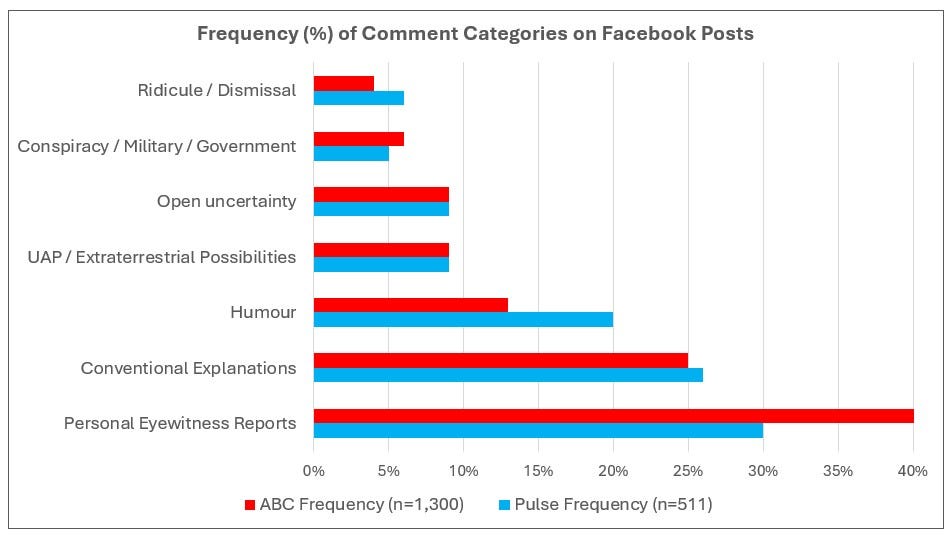
The Meander Valley lights story was posted on Facebook by Pulse Tasmania (177,000 followers), ABC Hobart (335,000 followers) and ABC Northern Tasmania (207,000 followers). 40 hours after posting there were around 1,800 comments in total.
A quick analysis using AI and spreadsheets revealed a more nuanced conversation than some might have expected. This analysis is about the nature of the discourse rather than attempting to identify the sightings.
Instead of polarising into simple “believers” and “sceptics,” the discussions revealed a much richer landscape of public sensemaking. Participants drew upon personal experience, technical knowledge, scientific reasoning, folklore, humour, institutional authority, and emerging UAP discourse to interpret the same observations.
The dominant focus of this spontaneous discourse was not about belief in extraterrestrials, but a widespread effort to understand ambiguous phenomena through collaborative discussion.
The Pulse Tasmania discussion remained largely focused on Tasmania, whereas the ABC post rapidly evolved into a national conversation. Thousands of commenters from every Australian state, along with New Zealand and overseas, reported observing remarkably similar lights over periods ranging from weeks to decades.
In effect, the ABC discussion became an informal crowdsourced observational database rather than merely a debate about a local news story.
Comments were categorised and graphed against relative frequency in percent.
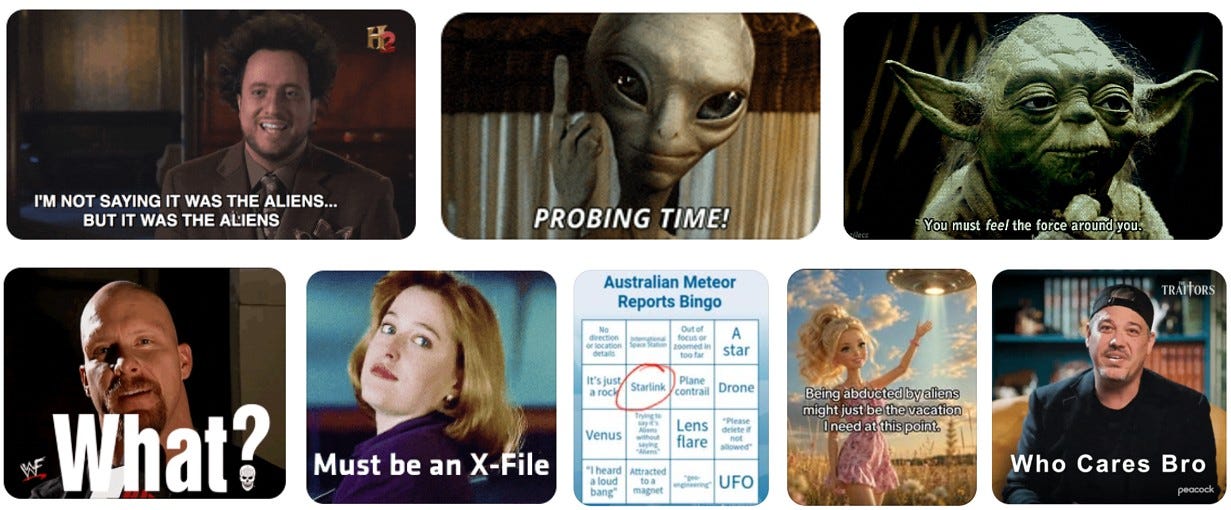
Humour appeared throughout both discussions.
Typical examples included:
“Beam me up” Star Trek references, X-Files references
Alien jokes, probing jokes, Area 51 jokes
Rather than functioning primarily to ridicule witnesses, humour appeared to act as a social lubricant that allowed participants to engage uncertainty without becoming confrontational.
Public Sensemaking Rather Than Public Belief
Traditional sentiment analysis often classify comments as positive, negative or neutral, but such categories don’t capture these more nuanced contributions.
Participants were not simply expressing opinions. They were negotiating questions such as:
What counts as reliable evidence?
Which experts should be trusted?
How should anomalous experiences be interpreted?
What explanations remain plausible?
How should uncertainty itself be managed?
These are questions of public epistemology rather than public opinion.
Four days after the above posts two more Australian news services published UFO-related Facebook posts: The Australian (1.3 million followers) and news.com.au (3.6 million followers). This provided an opportunity to analyse public UFO discourse across different and larger audiences.
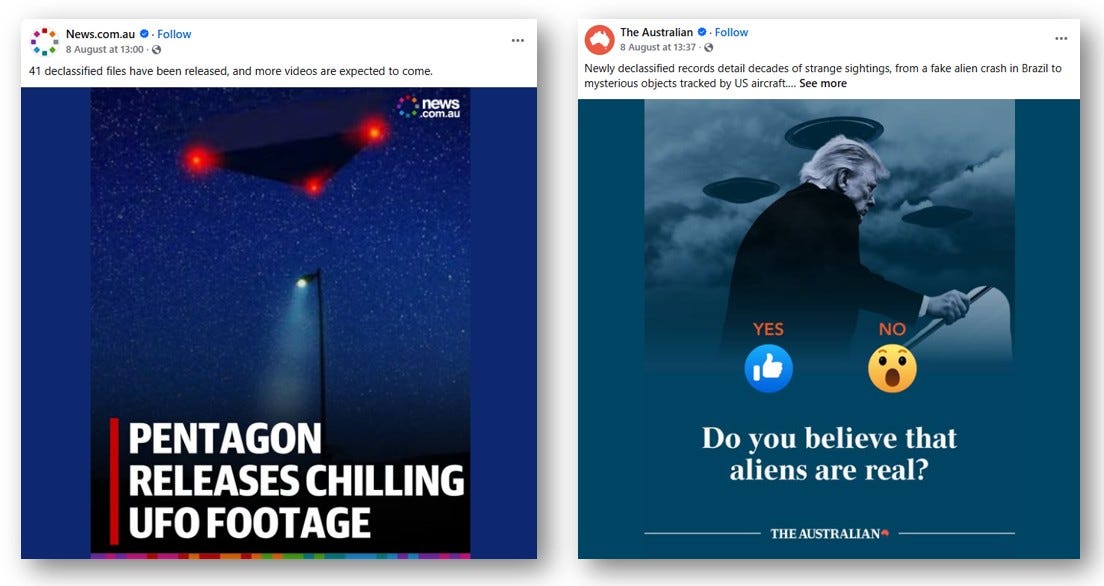
In The Australian’s simple poll, the YES (aliens are real) vote appears to be 94% of those who voted (n=4,926 on 11 Aug 2026).
In general, audiences differentiated ‘aliens are real’ from ‘aliens are visiting’. Many commenters noted that the statistical probability of life elsewhere in the universe is high.
Across the four Facebook discussions, the same broad interpretive elements recurred: eyewitness testimony, conventional explanations, belief in non-human intelligence, scepticism, humour, disclosure, conspiracy and distrust.
However, the relative importance of comment themes changed according to how the news outlets framed the story and the directions that different audiences took the conversation.
The following graph compares the relative frequency of different types of comments on The Australian and news.com.au (Produced with the assistance of AI and a spreadsheet.)
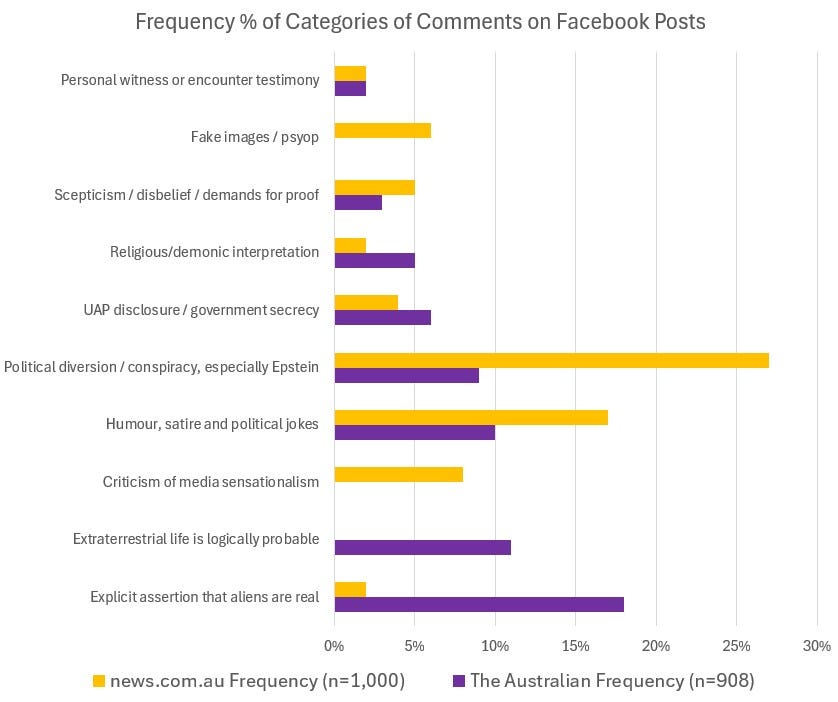
Together, these four Facebook discussions suggest that contemporary UAP discourse is evolving beyond a simple believer–sceptic debate into a broader negotiation over experience, evidence, ontology, expertise and institutional trust.
The main discourse isn’t whether people feel positively or negatively about UAP. It’s how people construct plausible realities when confronting ambiguous phenomena, and how that construction changes according to the way those phenomena are framed by media and institutions.
NOTE: This is not a rigorous study. The intention is to question our assumptions and generate dialogue about the nature of current public UAP/NHI discourse. At the same time this analysis tested the effectiveness and accuracy of using AI to rapidly analyse large amounts of text to assess shifting patterns in local and national UAP/NHI discourse.
Read a more detailed version of this analysis.