
UFO/UAP public discourse entered a new phase in June 2026 with the publication of two international papers focusing on how countries might prepare for different forms of public disclosure.
Preparing for Disclosure: A Public Health Framework for Paradigm-shifting Revelations – Unhidden (June 2026, UK & USA)
The Psychological Impact of UAP/NHI Disclosure: A Framework for Understanding Public Response and Preparedness – Disclosure Foundation (June 2026, USA)
Both present guiding frameworks recognising they complement existing systems and may need to be adapted to meet the needs, infrastructure and capacities of individual countries and their communities.
Both papers emphasise the worldview/paradigm changing potential of some current global issues such as artificial intelligence, the poly/meta-crisis and UAP disclosure. The frameworks identify possible preparatory actions to address likely psychological/health impacts of shifting realities for different populations.
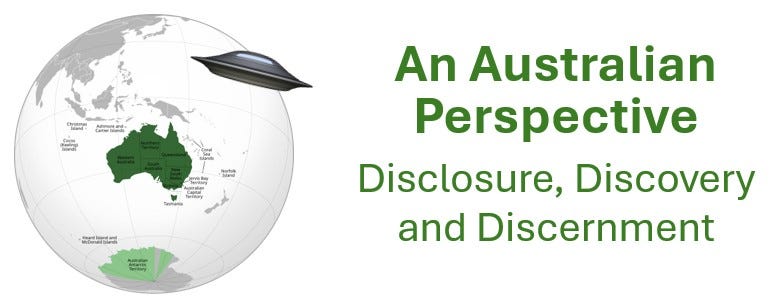
What might preparing-for-disclosure look like in Australia?
As an educator in Tasmania, Australia I decided to explore the above papers from an Australian perspective in a series of posts.
Part 1: An Australian Perspective
Australian Michelle McAllister (Oracular Visionary on Substack), began reflecting on the above papers in June: Is Australia Prepared for Disclosure?
Two linked papers explore the implications for the unique cultural, demographic and infrastructure landscape of Australia.
McAllister notes (paraphrased):
Disclosure, in whatever form it arrives, is best understood as a public health emergency requiring the same precautionary preparedness logic we already apply to pandemics, mass casualty events, and climate disasters.
Australia is unusually well placed to do this, because the architecture already exists. The work does not need to be framed as UAP preparedness at all. It sits naturally within ontological resilience and civilisational disruption planning, alongside AI transition scenarios and climate-related existential risk. The same architecture serves all of them.

Michelle McAllister also recognises the importance of citizen engagement with Parliament, launching a Disclosure Preparedness Australia campaign to involve Australian Senators and MPs.
Disaster Resilience
In addition to health networks, McAllister flags Australian disaster resilience architecture and frameworks as key assets in preparing for social and psychological disruptions triggered by emerging realities.
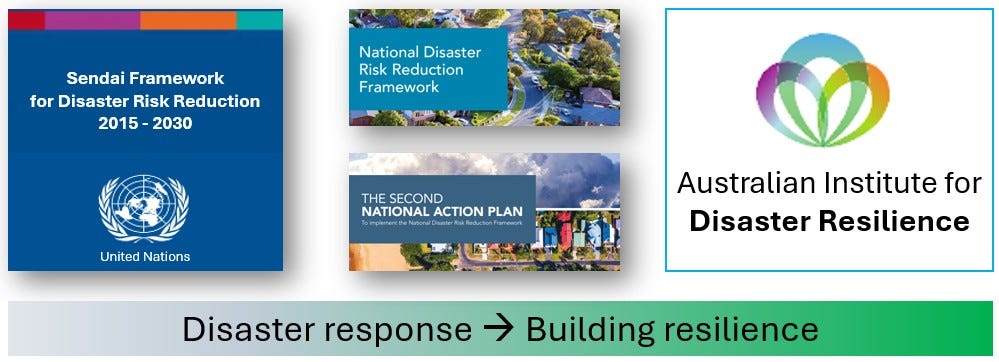
How might resilience practice evolve to support individuals, communities, and institutions in navigating profound uncertainty and transformation while maintaining coherence, agency, curiosity, and social cohesion?
One possible framing is “ontological resilience”: the capacity to remain curious, coherent, and adaptive when encountering circumstances, ideas, technologies, or events that challenge existing assumptions about the world.
Another framing is “ontological health”: which might be defined as the capacity to inhabit reality with coherence, meaning, openness and adaptability, especially when one’s understanding of self or world is disrupted.
“Ontological health is my proposal for what should come next: not as a finished answer, but as an invitation to build. A concept. A research agenda. A clinical posture. An informatics challenge. A public health concern. A way of saying that when human beings encounter something that breaks their inherited map of reality, their need for care does not begin after consensus arrives. It begins immediately.”
“Ontological health does not begin with belief. It begins with care.”
Education
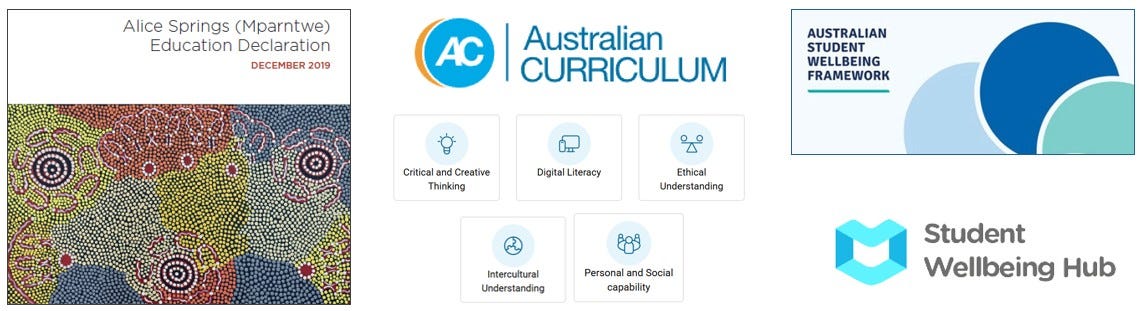
Education may have a greater role in preparing for disclosure than the international papers acknowledge.
These papers frame education as mostly reactive in a post-disclosure context: schools as buffers, counsellors as responders, media literacy as inoculation, educators as transmitters of calm.
However, they also implicitly point to a potential generative role for education:
They identify the absence of coherent interpretive frameworks as the primary driver of avoidable distress. Education already has a role in building understanding of conceptual frameworks.
Several capacities identified as important in preparing-for-disclosure are already embedded in the capabilities of Australia’s National Curriculum.
Aboriginal and Torres Strait Islander Histories and Cultures are already a cross-curriculum priority bringing relational and more-than-human cosmologies into the Australian education system.
The Australian Student Wellbeing Framework is a whole-school approach promoting leadership, inclusion, student voice, partnerships and support.
Worldview Journeys
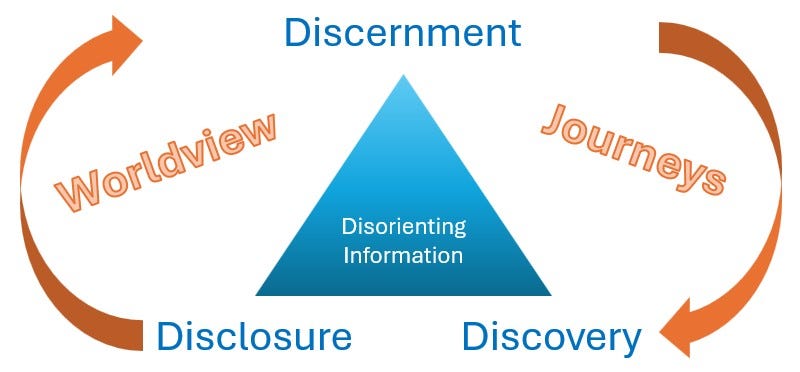
According to transformative learning theory, this involves stages/cycles of disorientation, questioning and the discovery of new possibilities. (Source) Shifting worldviews or paradigms can then bring new ways of knowing and sense-making (epistemology) and altered values/ethics (axiology).
This brings additional challenging layers to an already complex dynamic of disclosure-discovery-discernment.
Individuals, groups, communities, support services, institutions, countries…
are likely to be engaged in unique ‘worldview journeys’ as they process disorientating information and adopt new conceptual frameworks
in their own ways and in their own time.
How do worldviews and worldview journeys in Australia differ from those in the U.S. and other countries?
What are the dominant worldviews of trusted information sources and support services in Australia?
What advantages and limitations might indigenous, ancient, eastern, western (traditional, modern, postmodern, integrative… )… worldviews bring to cycles of disclosure, discovery and discernment?
How might Australian and global UAP/NHI experiencer research and networks inform disclosure preparation initiatives?
How quickly can Australian institutions respond to changes in worldview socio-demographics?
What role might Australian education play in acknowledging worldview/paradigm diversity, facilitating meaningful exchanges across worldviews, and supporting worldview journeys?
https://www.amazon.com/D-After-Disclosure-Government-Finally/dp/1601632223
A.D. After Disclosure: When the Government Finally Reveals the Truth About Alien Contact
This was written several years ago by Byce Zabel and Richard Dolan. It’s very grounded, realistic ,speculative fiction, and really addresses the US situation, but it’s still relevant. I’ve felt for a long time that no one nation should be in charge of disclosure. When it’s made, a world body (UN maybe?) should make the formal announcement, with each nation making their own decisions on the details, due to cultural, spiritual, and ontological shock that will surely follow.