Contrasting UFO/UAP Research Approaches
"We don't know what they are" - and other UAP Clichés

As an educator, I’m interested in the journeys of those engaging with the UFO/UAP issue. Sense-making frameworks such as worldviews may help us navigate this extraordinary moment in human history.
Current views on the UAP topic include:
a) “There is nothing to see.”
b) “Something’s there, but we don’t know what it is.”
c) “This isn’t new, and we do have some idea what we are encountering.”
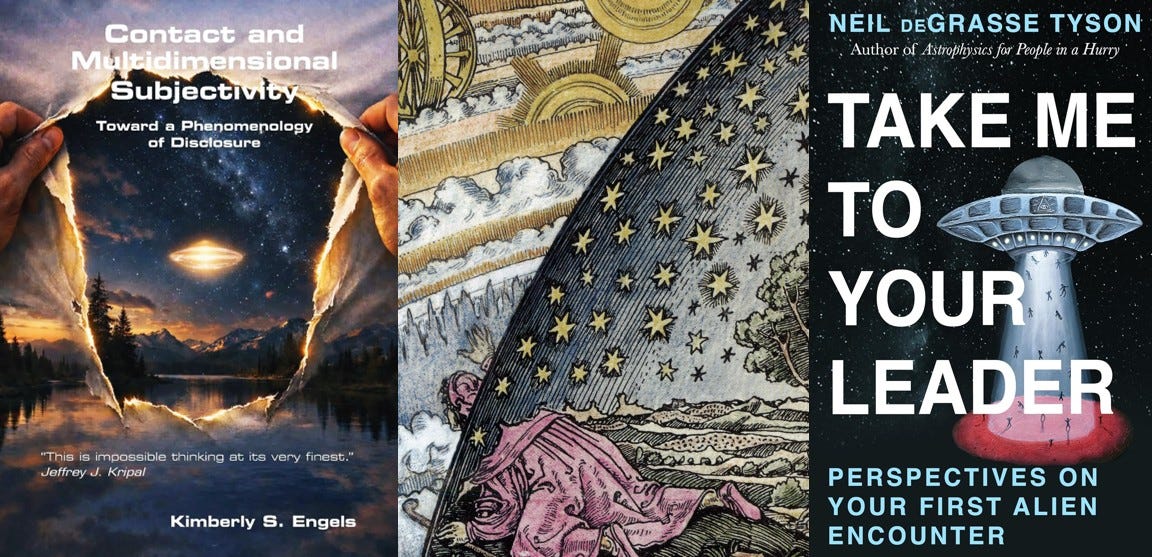
These differences are likely to be just as much about human culture and behaviour as the identification of UFO/UAP. Two recently published books highlight views a) and c). View b) is considered in the UAP Clichés section below.
View a) – “There is nothing to see.”
For astrophysicist and science communicator Neil deGrasse Tyson, there’s nothing to see. He believes (or knows with a high level of confidence) that while extraterrestrials are likely to exist far away within this or other galaxies, there’s no evidence they have ever visited Earth.
In Take Me To Your Leader (May 2026) Tyson explains that he’s only interested in “gold standard” physical objective evidence. Furthermore, for UFOs he requires “extraordinary evidence” such as alien craft or bodies to be handed to him.
Many would agree with him: “Just show us the craft and aliens.” This approach sets a high evidentiary bar, while also deferring UAP research to official disclosure policies, narratives and timelines.
While promoting his book (75min video) Tyson explained that it’s more likely very credible witnesses have been mistaken, than they actually saw alien craft or bodies. He remains unconvinced – unless someone provides incontrovertible hard physical evidence – preferably aliens that are not humanoid.
There’s no doubt the physicalist/naturalist scientific approach is extremely valuable, and there are many examples of UAP later being identified with prosaic causes. However, this approach leaves possible explanations off the table, privileges objective data, and limits the range of anomalous phenomena likely to be identified.
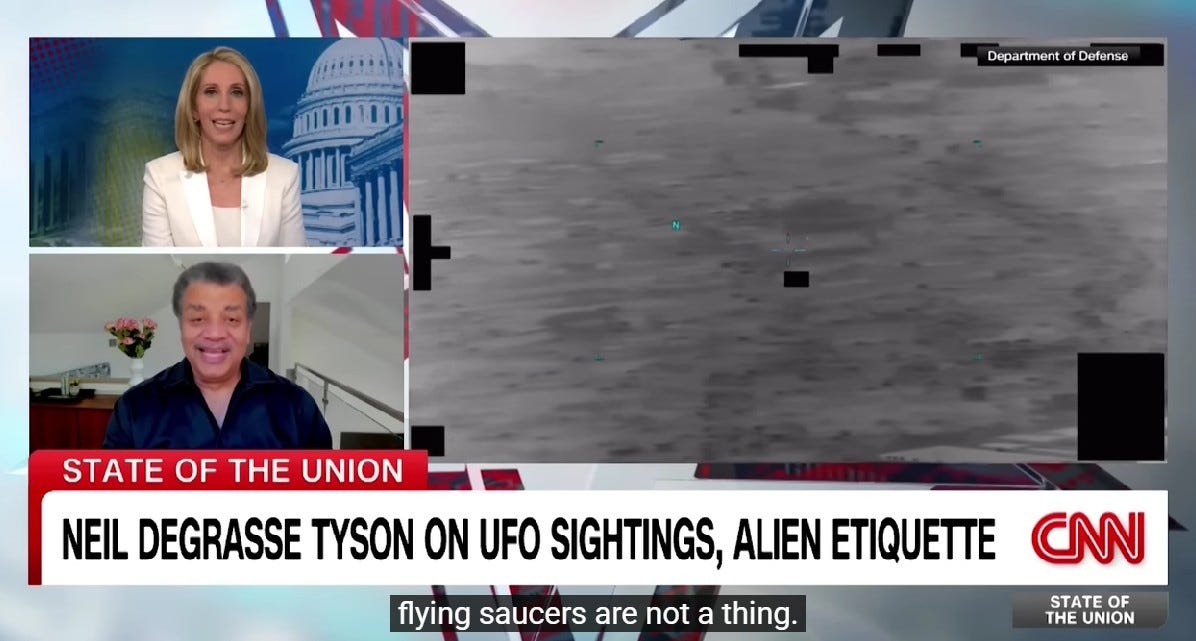
In the above CNN interview (18 May 2026 - 10min video) Tyson says he wrote Take Me To Your Leader to celebrate human imagination and culture in the alien genre.
View c) – “This isn’t new, and we do have some idea what we are encountering.”
For philosopher and UAP studies researcher Kimberly Engels, UAP are not new and there are methodologies that enable critical and meaningful discernment of UAP encounters.
In Contact and Multidimensional Subjectivity: Toward a Phenomenology of Disclosure (April 2026) Engels uses generative and interpretive phenomenology “to step into the [UAP] experiencers’ lived world and bear meaningful witness to their encounters and insights.”
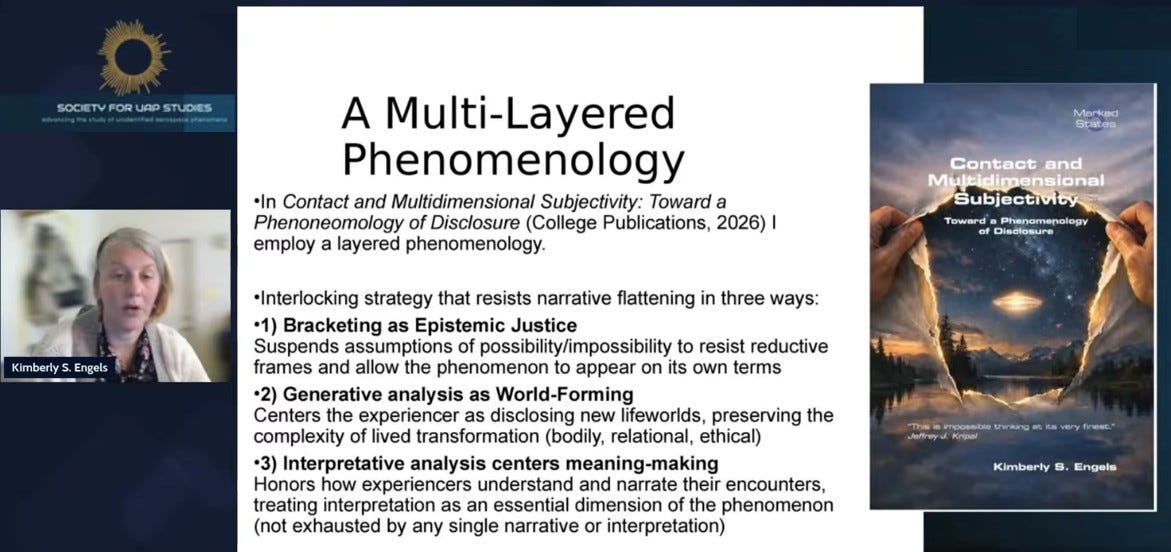
Image source: Video - Resisting Narrative Flattening: Epistemic Justice for Experiencer Testimony (1 May 2026 - 100mins)
Engels is critical of the harm done by ignoring or only partially witnessing UAP experiencer accounts. “Too often these encounters are dismissed off-hand as ‘impossible,’ or only considered if they support researchers’ chosen hypothesis…”
Engels recognises Miranda Fricker’s notion of the epistemic injustice of partial, failed and refused witnessing. This includes testimonial injustice where UAP encounter testimony “is not given adequate weight or credibility” and hermeneutical injustice where “society lacks the concepts and language to name and witness their experiences in a meaningful way.”
Partial witnessing can result in the pathologising of experiencers (eg abductions must be hallucinatory) when their accounts are reduced to fit dominant social ontologies or flattened into familiar categories to fit contemporary scientific or academic narratives.
While phenomenology may not identify the exact sources of UAP “it can tell us how these phenomena appear and are experienced.” This then points to the ways in which our models of reality and our understanding of what it means to be human may need revision or expansion “beyond the edges of scientific consensus reality.”
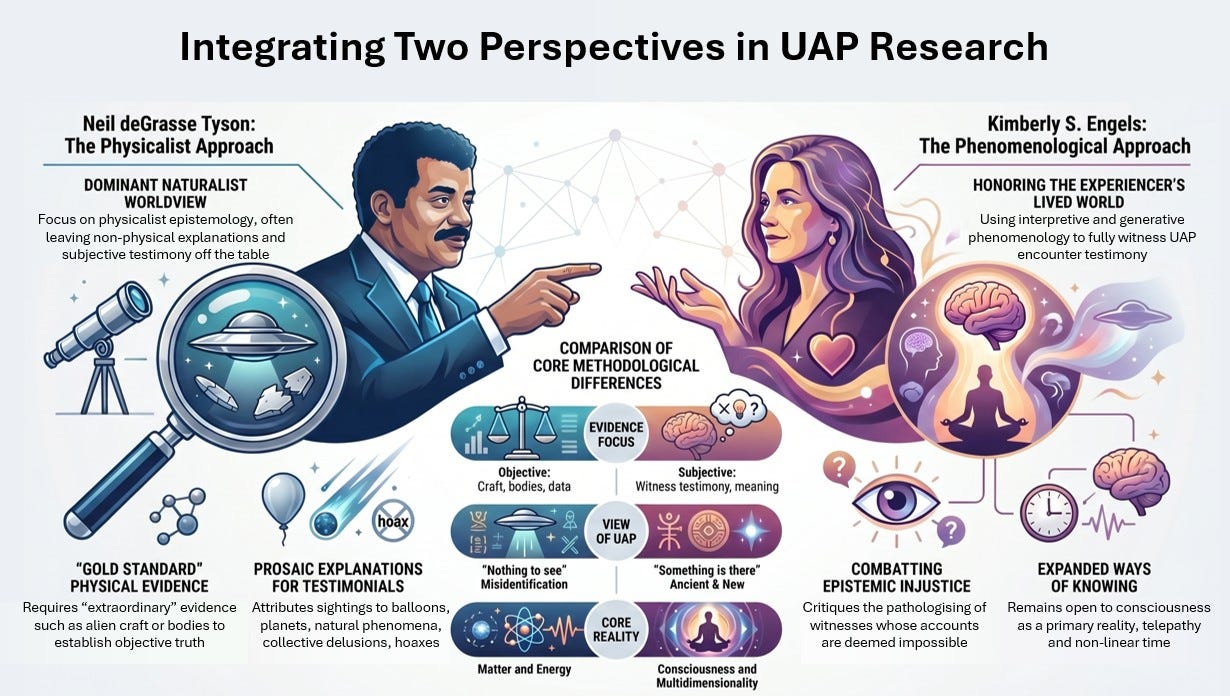
Image source: AI generated highlighting the different approaches - although perhaps a little simplistic.
In summary, the scientific approach has significant strengths when dealing with some aspects of UAP, but it says little about the human experience of the phenomena. Generative and interpretive phenomenology add important additional lenses through which UAP may be examined. These phenomenological approaches also challenge our assumptions and open up new possibilities for exploration.
UAP Clichés
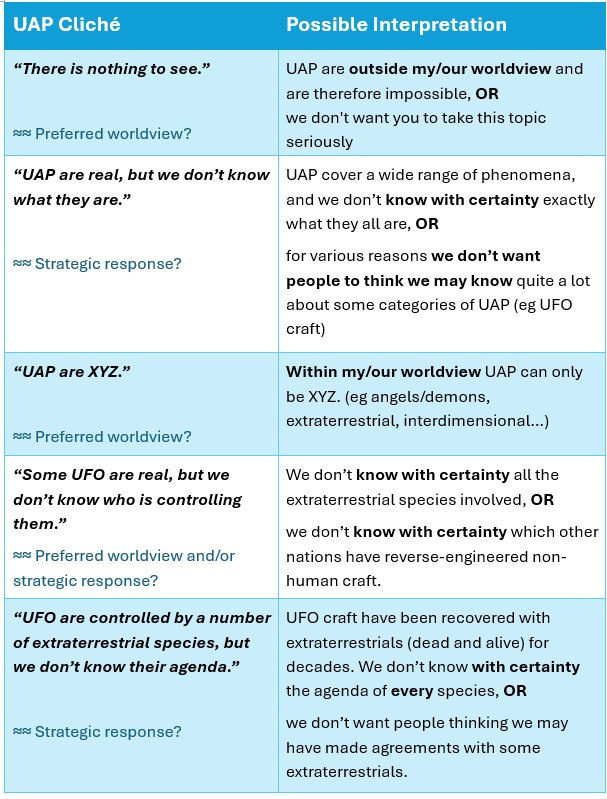
Institutional and public UAP discourse is full of clichés which may reveal more about the authors’ methodologies, worldviews or agenda than the actual state of knowledge of the phenomena.
The following table presents five common UAP-related clichés with speculative interpretations sourced from various UAP forums. Some statements are more definitive based on preferred worldviews; others may be strategically vague or misleading for secrecy or plausible deniability. You may have your own examples.
Note: There are many more UAP research methodologies and worldviews. This post focuses on physicalist science and phenomenology explored in the two recently published books.